

 English
 Español


Industry News
Home / News / Industry News / Plastic Injection Molding Cost: Real Per-Part and Tooling Price Ranges
Content
A 38-gram glass-filled nylon bracket, 60,000 pieces a year, one drawing. The first molder quotes $1.85 per part plus $28,000 for tooling. The second quotes $0.94 per part plus $61,000 for tooling. The third quotes $1.42 with no tooling line at all, because the mold is amortized into a three-year piece price. The spread on the part is nearly 100 percent, and the spread on the tool is more than 100 percent. Nothing about the drawing changed between those three quotes.
That is the reality of plastic injection molding pricing. It is not a catalog item with a list price. It is a calculation built from resin cost, machine time, cycle time, cavitation, scrap rate, tooling strategy, and volume — and every molder weights those inputs differently. This article gives you the actual numbers behind the calculation, shows where the money goes, and explains why two quotes for the same part can differ by a factor of two without either molder being dishonest.
Most injection molded parts land between $0.05 and $6.00 per piece at production volume, excluding tooling. The extreme low end belongs to tiny, high-cavitation electronic components and medical consumables made in millions. The extreme high end belongs to large, low-volume structural housings with slow cycles and expensive engineering-grade resins. Tooling sits on top of that, typically $3,000 to $250,000 depending on size, cavity count, steel grade, and complexity.
The table below shows the ranges we see most often across five common part categories. Treat these as planning bands, not quotations — resin prices move with feedstock markets, and machine rates vary enormously by region.
| Part category | Typical shot weight | Annual volume | Per-part price | Tooling investment |
|---|---|---|---|---|
| Precision electronic part (connector, relay housing, micro gear) | 0.5-15 g | 250,000-5,000,000 | $0.05-$0.60 | $8,000-$45,000 |
| Home appliance part (vacuum housing, AC casing, refrigerator drawer) | 100-800 g | 20,000-300,000 | $0.80-$6.00 | $25,000-$180,000 |
| Automotive interior or structural part | 50-600 g | 50,000-500,000 | $0.60-$4.50 | $20,000-$150,000 |
| Medical consumable (syringe barrel, infusion connector, test tube) | 3-40 g | 500,000-50,000,000 | $0.03-$0.35 | $15,000-$90,000 |
| Two-shot or overmolded part | 20-200 g | 50,000-1,000,000 | $0.50-$5.00 | $35,000-$200,000 |
Two things stand out in that table. First, the per-part price is inversely related to volume far more strongly than most buyers expect, because tooling amortization and setup dominate small runs. Second, the tooling number is often larger than the first year of production cost for anything under 50,000 pieces. If your program is small, tooling strategy is your main cost lever, not resin or machine time.
Every credible injection molding quote reduces to five inputs. When a quote looks strange, one of these five is being weighted differently. Understanding them lets you interrogate a quote instead of simply accepting or rejecting it.
Material is the single largest line item for most parts. Commodity resins such as polypropylene, polyethylene, and polystyrene typically run $1.00 to $1.80 per kilogram. Engineering grades climb quickly: ABS and PC/ABS land around $1.40 to $2.20 per kilogram, unfilled polycarbonate around $2.50 to $3.50, glass-filled PA66 around $3.00 to $4.50, and high-performance resins such as PEEK, PPSU, and PEI can exceed $50 per kilogram.
Because the shot weight, not the finished part weight, drives material cost, the runner system matters. A cold-runner mold with a heavy sprue can waste 20 to 40 percent of every shot as regrind. A hot-runner system eliminates most of that waste but adds $8,000 to $40,000 to the tool and consumes more energy per cycle. Whether the hot runner pays for itself depends almost entirely on your volume and your resin price — a rule of thumb is that hot runners break even somewhere between 100,000 and 300,000 shots for commodity resins, and much sooner for expensive engineering grades.
Machine time is billed at an hourly rate that bundles the press, the operator, the chiller, the dryer, the material handling system, and factory overhead. Rates vary by tonnage and region. A 50-150 ton machine might run $15 to $35 per hour in China and $40 to $80 per hour in North America. A 250-500 ton machine might run $30 to $60 per hour in China and $75 to $150 per hour in North America. European rates typically fall between the two.
The tonnage you need is set by the projected area of the part and runner multiplied by the cavity pressure required by the resin. A practical rule for common thermoplastics is 2 to 5 tons of clamp force per square inch of projected area, with higher values for high-viscosity or highly filled materials. Select too small a press and you get flash and dimensional drift. Select too large a press and you pay for capacity you never use. The second mistake is more common and more expensive over a program's life.
Part cost scales linearly with cycle time and inversely with the number of cavities. A 30-second cycle produces 120 shots per hour. With a four-cavity mold that is 480 parts per hour; with an eight-cavity mold it is 960. Doubling cavitation nearly halves machine time per part, which is why high-volume parts are almost always run in multi-cavity tooling despite the tooling premium.
Cooling dominates cycle time for most parts. As a rule of thumb, doubling nominal wall thickness roughly quadruples cooling time, because heat has to travel through the section. That is why a wall reduction from 3.0 mm to 2.4 mm can cut cycle time by a third or more while also reducing shot weight. It is the single most powerful cost lever a designer has, and it costs nothing to specify.
Direct labor per part is small on a well-automated press and significant on a manual one. A press with a robotic take-out arm and a centralized material system can run with one operator overseeing several machines. A press running loose parts into a gaylord box with manual inspection may need one operator per machine. That difference shows up in the quote as a 15 to 30 percent swing in the labor and overhead line.
Yield is the quiet one. A mature, well-tooled process might scrap 1 to 3 percent of production. A new tool with a warping problem, a short-shot issue, or a cosmetic defect can scrap 10 to 15 percent during the first weeks. Molders price that risk into the quote, so a part with difficult geometry carries a scrap allowance you will pay for whether or not the scrap materializes.
Tooling is a fixed cost spread across whatever quantity you buy. On a 10,000-piece order, a $40,000 mold adds $4.00 to every part. On a 400,000-piece order it adds $0.10. This is the main reason the same part appears to cost four times more at low volume than at high volume — you are not being charged more for the part, you are being charged for the mold in a shorter window.
Ask explicitly whether the quote amortizes tooling into the piece price or bills it separately. Both are legitimate. The difference matters for cash flow, for tool ownership, and for what happens if you move the program to another supplier later.
Mold price is driven by six variables: part size and projected area, number of cavities, steel grade, runner type, mechanical actions such as slides and lifters, and surface finish requirement. A single-cavity prototype tool in P20 steel for a small bracket might cost $1,500 to $4,000. A hardened eight-cavity production tool with a hot runner for a precision connector might cost $18,000 to $35,000. A large automotive tool with two slides, a hot runner, and a class A finish can run $60,000 to $250,000.
| Tooling class | Cavities | Steel and runner | Typical cost | Typical lead time |
|---|---|---|---|---|
| Prototype / bridge tool | 1-2 | P20 or aluminum, cold runner | $1,500-$6,000 | 2-4 weeks |
| Small precision production tool | 4-16 | Hardened H13 or S136, hot runner | $12,000-$45,000 | 5-9 weeks |
| Mid-size appliance or consumer tool | 2-8 | P20 or 718H, hot runner | $25,000-$90,000 | 7-12 weeks |
| Large automotive structural tool | 1-4 | Hardened steel, hot runner, slides | $60,000-$250,000 | 12-20 weeks |
| Two-shot / multi-material tool | 2-8 + 2-8 | Indexing or core-back design | $35,000-$200,000 | 10-18 weeks |
A $12,000 mold and a $22,000 mold for the same part will both produce acceptable parts on day one. The difference appears in month eight. Cheaper tools typically use softer steel, thinner plates, fewer cooling channels, and looser fits. They run slower cycles because cooling is uneven, they need more maintenance, and they drift out of tolerance sooner. If your program runs 50,000 parts over three years, that gap may never matter. If it runs two million parts, a soft tool can cost more in downtime and replacement than the premium tool would have cost outright.
Ask two questions before you approve a tool: what steel is in the cavity and core, and how many cooling circuits does the core have. Those two answers tell you more about tool life and cycle time than any brochure.
Confirm in writing who owns the mold, where it is stored, and what it costs to transfer it. If you later move the tool to another molder, ask for the mold drawing package, the waterline diagram, and the setup sheet. A tool without documentation is difficult and sometimes impossible to run elsewhere. Standard wear items — ejector pins, springs, hot-runner tips, seals — should be replaced on a defined schedule rather than after a failure, because a failed ejector pin can destroy a cavity insert.
Numbers make the formula concrete. Take a 38-gram part in 30 percent glass-filled PA66, running in a four-cavity hot-runner mold on a 180-ton press, 45-second cycle, 150,000 parts per year. Resin is quoted at $3.60 per kilogram. Machine rate is $28 per hour, all-in.
The shot weight is roughly 175 grams including the hot-runner drop, so material cost is 0.175 kg × $3.60 = $0.63 per shot, or $0.158 per part across four cavities. Machine time is 45 seconds ÷ 3,600 = 0.0125 hours at $28, which is $0.35 per shot, or $0.0875 per part. Add labor, quality, packaging, and overhead at a typical 25 to 35 percent of the conversion cost — roughly $0.03 per part. Apply a 3 percent scrap allowance and the per-part cost lands near $0.285.
Now change one variable. Increase wall thickness by 25 percent to add stiffness. Cycle time rises to roughly 60 seconds because cooling time is thickness-driven, and shot weight rises to 205 grams. Material cost becomes $0.185 per part and machine time becomes $0.117 per part. The part now costs about $0.33. A geometry change that felt free at the CAD stage just added 16 percent to the piece price on 150,000 parts — roughly $7,500 a year, every year.
That is the practical value of understanding the formula. You can argue about a molder's hourly rate for weeks and move the needle by 5 percent. You can change a rib, a boss, or a nominal wall in an afternoon and move it by 15 percent.
Volume affects price through three separate mechanisms, and they do not scale at the same rate. First, tooling amortization falls hyperbolically — cutting the amortization burden fastest in the first 100,000 pieces. Second, the molder can justify more cavities and a hotter runner, which reduces machine time per part. Third, fixed setup, sampling, and quality documentation costs spread across more units.
A realistic pattern for the bracket above, with tooling quoted at $32,000:
The lesson for buyers is that comparing quotes at different volumes is meaningless. If one supplier prices at 10,000 pieces and another at 500,000, the lower number tells you nothing except that they assumed a bigger order. Always normalize quotes to the same annual volume, the same tooling ownership model, and the same Incoterm.
The piece price and the tool are the two numbers on the quote, but they are rarely the two biggest numbers on the program. The costs that surprise buyers are the ones outside the molding cell.
None of these are hidden in a dishonest sense. They are simply outside the scope of a per-part quote, and they need to be on your total-cost spreadsheet from day one.
Automotive programs price differently from consumer programs because the tooling has to survive years of production with minimal unplanned downtime. An interior trim piece molded in ABS might run 300,000 cycles over a model life. A dashboard or instrument panel component may run in a family tool with multiple inserts and complex cooling. Tool steel selection, cooling layout, and the ability to hold a class A surface for years matter more than the initial mold price.
 Automotive Dashboard Injection Molds for OEM/ODM ProductionFor dashboard frameworks, trim strips, and touch panels, these molds use modified PP, PC/ABS, and reinforced nylon for automotive interior parts.View Product →
Per-part prices for automotive parts typically sit between $0.60 and $4.50 for components in the 50 to 600 gram range, with the material line rising fast when glass-filled or UV-stabilized grades are specified. Two cost items appear in automotive quotes that rarely appear elsewhere: paint or film-insert decoration, and dimensional documentation tied to customer-specific tolerance stacks. Both add cost that is invisible in the resin and machine-hour lines.
Cycle time optimization is worth attention here because automotive volumes are high enough that a two-second cycle reduction on a 500,000-piece program saves real money. A two-second improvement on a 45-second cycle is about 4.4 percent of machine time. On a part with a $0.10 machine-time component, that is roughly $0.004 per part, or $2,000 across the program — modest, but it compounds when a tool family carries several parts. For a broader look at the component types involved, the site's overview of automotive accessory applications shows how dashboards, interior trim, and lighting parts differ in tooling demand.
The practical advice for automotive buyers is to specify tool life explicitly in the purchase order. "Production tool, 500,000 cycles minimum, H13 cavity and core, documented cooling circuits" is a sentence that will save you an argument later. Without it, both parties are guessing at what "production tool" means.
Precision electronic components often weigh under 10 grams and still cost as much per part as a 300-gram appliance housing. The reason is that the cost is not in the material, it is in the tool, the tolerances, and the process control. A micro gear or connector housing may need tolerances of plus or minus 0.02 mm, which requires a hardened multi-cavity tool, tight process windows, and inspection that goes far beyond a visual check.
 Electronic Connectors Injection Molds for Precision OEM/ODM ComponentsHigh-temperature LCP and PA9T connector molds support thin-wall molding, electrical insulation, and customization for 5G, automotive, medical, and industrial applications.View Product →
Engineering resins dominate this category: LCP, PBT, PA46, PPS, and high-flow PC grades. Many of them cost $4 to $15 per kilogram, which reverses the usual cost structure — material can be 40 to 55 percent of the part price even at a 6-gram shot weight. Because the parts are small, cavitation is high: 8, 16, or even 32 cavities are normal. That reduces machine time per part to a fraction of a cent but raises tooling cost and raises the stakes on cavity-to-cavity balance.
Three cost traps are specific to precision electronics. First, overly tight tolerances on dimensions that do not matter functionally — every unnecessary tolerance costs inspection time. Second, insufficient cooling in a small tool, which forces a longer cycle than the part geometry requires. Third, regrind policies. Many precision parts cannot accept regrind because of dielectric or dimensional effects, which means the runner is scrap rather than recycled material. Where a cold runner wastes 30 percent of the shot, that waste is charged at full virgin resin price, not at a regrind discount.
A syringe barrel and an identically shaped cosmetic tube are not the same product, and they are not the same price. Medical parts carry validation documentation, cleanroom or controlled-environment production, resin traceability, and often single-use tooling policies. A polypropylene medical grade can cost $3 to $8 per kilogram against $1.10 to $1.60 for an equivalent commodity grade — a two- to five-fold material premium before any process cost is added.
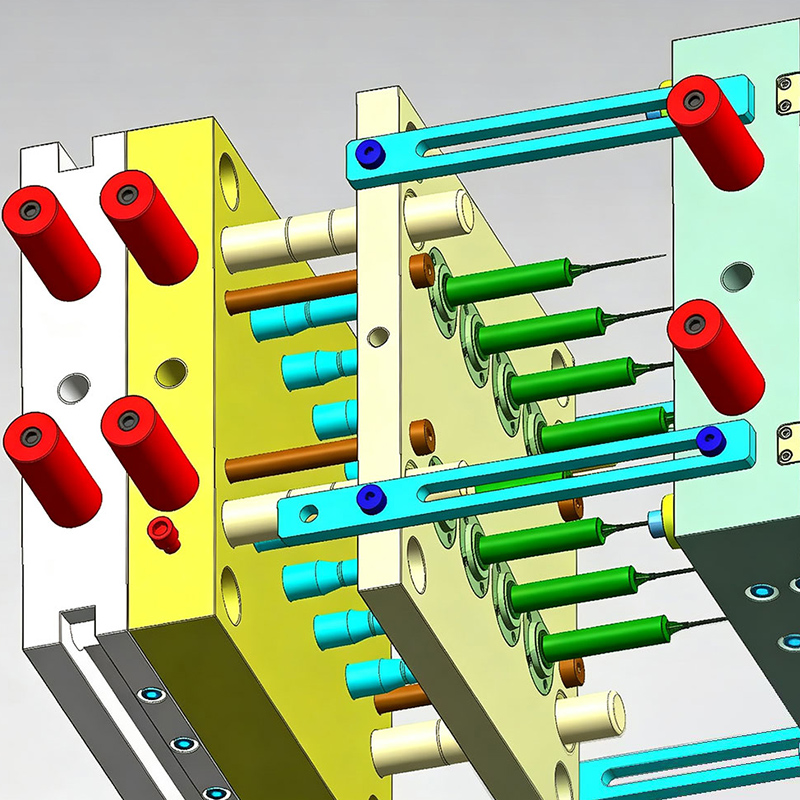 Medical Syringe Injection Molds for High-Transparency OEM/ODM ProductionThese multi-cavity molds use medical-grade PP, PC, and COP/COC to produce transparent syringe components for sterile, prefilled, contrast media, and insulin delivery devices.View Product →
Tooling costs in this segment reflect the same discipline. Medical tools are typically built in hardened stainless or high-polish steels, with hot runners designed for minimal dead spots, and the tool is usually dedicated to one product with documented maintenance records. A 16-cavity medical consumable tool can cost $40,000 to $90,000, and that is before validation. Add first-article inspection, dimensional layout, and process capability studies and the program cost rises further.
The offsetting factor is volume. Medical consumables often run in the tens of millions, which pushes amortization to near zero and rewards cavitation. Where a consumer part might run a four-cavity tool, a medical barrel might run 32 or 48 cavities in a stack mold, producing hundreds of parts per minute. At those volumes, a one-second cycle improvement is worth more than any negotiation on resin price. Understanding how these programs differ from general-purpose molding is useful context; this overview of medical injection molding explains the regulatory and process-control layer that sits on top of the ordinary cost formula.
Appliance housings, vacuum cleaner bodies, air conditioner casings, and refrigerator drawers are usually large, visible, and price-sensitive. A 400-gram ABS housing on a 650-ton press with a 55-second cycle consumes roughly 0.11 hours of machine time per shot. At $55 per hour, that is $6.05 per shot before material, or about $1.51 per part in a four-cavity tool. Add 0.42 kg of shot weight at $1.60 per kilogram — about $0.17 per part — and the conversion cost dominates. For these parts, the tooling and cycle-time decisions matter far more than resin selection.
Consumer and appliance programs are also where color changes, family tools, and texturing show up most often. A family tool that produces a left and right housing in one shot saves an entire machine and reduces handling, but it also means a defect in one cavity stops the whole tool. Molders price that risk. When you compare quotes for a large housing, ask whether the tool is a single-part or family layout, because the piece price difference between the two is often 10 to 20 percent and reflects a genuine risk transfer.
Wall thickness discipline is decisive here. A housing with a 3.2 mm nominal wall on a 500-ton press can frequently be reduced to 2.5 mm with rib reinforcement and run on a 380-ton press with a shorter cycle. That single change can reduce machine rate, shot weight, and cycle time simultaneously — the rare case where one design decision moves three cost lines in the same direction.
Roughly 70 percent of a molded part's cost is locked in before the first tool is cut. That is why cost conversations held at the quoting stage are almost always less productive than cost conversations held at the design stage. The highest-leverage decisions are geometric and metallurgical, not commercial.
One additional design lever is easy to overlook: part consolidation. Replacing three molded parts and two assembly steps with one molded part frequently costs more per part and less per assembly. If the cost model stops at the molding cell, that decision looks wrong. If it includes assembly labor, fasteners, and inventory, it usually looks right.
Quote accuracy is a function of input quality. A molder given a single PDF drawing and told "give me a ballpark" will add a risk buffer, and you will pay for that buffer whether or not the risk materializes. A complete quote package typically cuts the buffer substantially and shortens the turnaround from weeks to days.
Two of these deserve emphasis. Volume pattern matters more than volume total, because it determines tooling cavitation and machine scheduling. And surface finish matters more than most buyers expect, because a high-gloss or texture requirement can force a different steel and a slower cycle. A molder who receives all nine items can quote with confidence. A molder who receives two will quote with a cushion.
Quote comparison fails most often because the quotes are not comparable. Before comparing numbers, normalize four things: volume, tooling treatment, Incoterm, and quality scope. A quote at 50,000 pieces with tooling amortized is not comparable to a quote at 20,000 pieces with tooling billed separately, and the gap between them can easily exceed 80 percent.
Then look past the number. Ask what cycle time and cavitation the quote assumes. Ask what scrap rate is built into the piece price and whether a lower scrap rate would reduce it. Ask what the tooling lead time is and what the sampling process looks like — a single sampling round followed by production, or two rounds with a formal approval gate. Quotes with identical totals can hide very different assumptions, and the assumptions are what you will live with for the next three years.
Finally, treat the lowest quote with the same scrutiny as the highest. A quote that is 30 percent below the others is usually one of four things: a different volume assumption, a lighter tool, an incomplete scope, or a supplier buying the business to fill capacity and planning to recover the margin later. None of those are automatically disqualifying, but all of them deserve a direct question before you sign.
The cost levers with the largest effect are almost all engineering decisions, and they cost nothing to specify if they are made before the tool is cut.
Notice that only one of these ten is a commercial negotiation. The rest are design and process decisions. Buyers who focus on pressuring the hourly rate are competing for the smallest available slice of the cost pie.
The same avoidable errors appear across programs in every industry. They are not exotic; they are just easy to make when a launch schedule is tight.
Each of these adds cost in a different line of the budget, which is why they are hard to catch in a single review. A checklist used at the design freeze and again at the tooling purchase order catches most of them.
Plastic injection molding cost is not a mystery and it is not arbitrary. It is a calculation built from material, machine time, cycle time, cavitation, yield, and tooling amortization, with a risk allowance layered on top for whatever the supplier cannot verify. When a quote comes in higher than expected, the productive response is not to ask for a discount — it is to ask which of the five inputs is driving the number.
In practice, the largest savings are available before the first purchase order is issued. A wall thickness decision made in CAD, a cavitation choice made before the tool is designed, and a tolerance review made at the drawing stage routinely move a program's cost by double-digit percentages. Negotiating the hourly rate after that point is a rounding exercise. Start with the geometry, the volume, and the tooling strategy — and ask for a quote that separates them clearly enough that you can see which lever to pull.
 View More View More
 View More View More View More
 View More

+86-18939901200

+86-021-57800460

shpzsj@163.com

No. 88, Yechang Road, Yexie Town, Songjiang District, Shanghai, China
 Custom Precision Plastic Injection Mold Manufacturers